

Tennessee Attorney General Jonathan Skrmetti Warns of AI Risks to Children on the RegulatingAI Podcast with Sanjay Puri
RegulatingAI Podcast
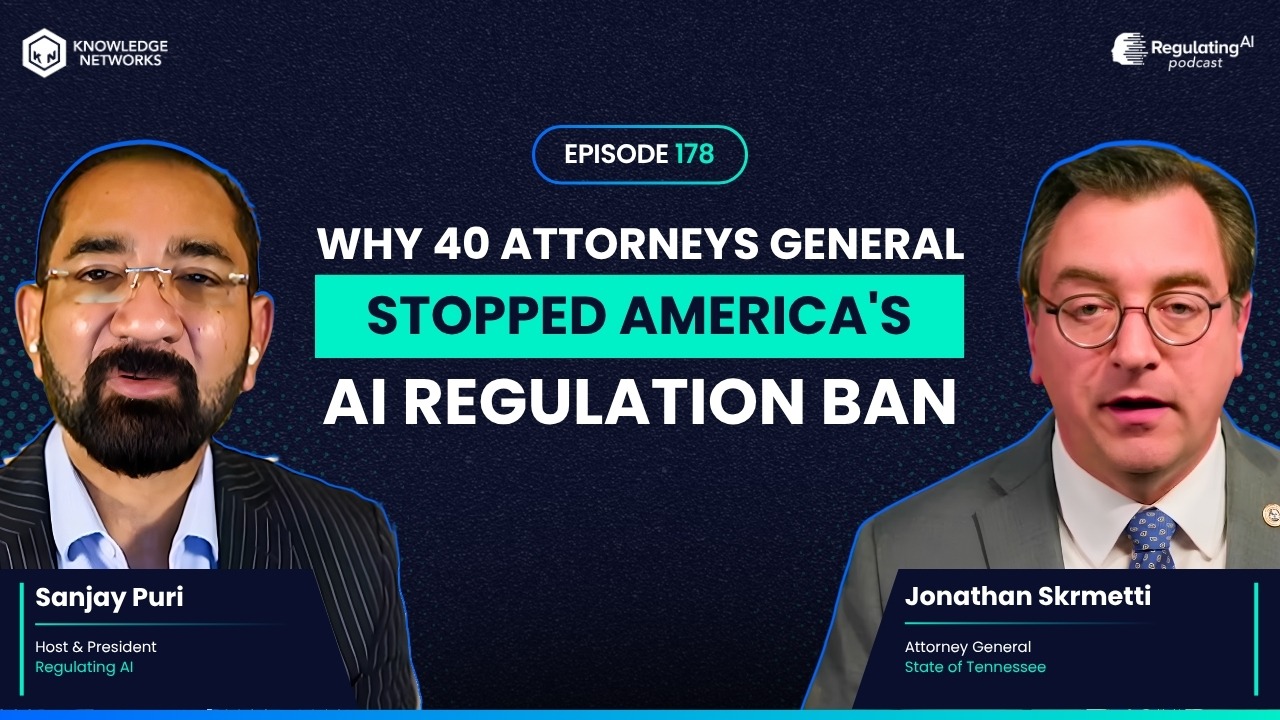
Jonathan Skrmetti, Attorney General of the State of Tennessee with Sanjay Puri, President of RegulatingAI
On the RegulatingAI Podcast, Tennessee AG Jonathan Skrmetti urged balanced AI governance, and stronger child protections without stifling innovation.
According to Skrmetti, the proposal would have created a dangerous regulatory vacuum at a time when AI technologies are evolving rapidly. While he acknowledged the need for a coherent federal framework, he argued that states currently serve as the primary line of defense against consumer harm. Until comprehensive federal legislation exists, he said, state authorities must retain the ability to enforce consumer protection, privacy, and antitrust laws. The discussion also explored the growing role of AI in antitrust enforcement. Skrmetti highlighted the landmark RealPage case, in which state attorneys general joined the U.S. Department of Justice in alleging that algorithmic pricing tools enabled landlords to coordinate rents without direct communication. He emphasized that technology should not be used to circumvent existing laws, arguing that collusion conducted through algorithms should be treated the same as collusion conducted in person. However, the most urgent part of the conversation focused on children and AI.
Skrmetti warned that AI poses risks that are more immediate and personal than those associated with previous technologies such as social media. While social media platforms often rely on addictive engagement mechanisms and questionable content, AI systems introduce a new level of personalization. Chatbots can quickly adapt to a user’s emotions, behavior, and vulnerabilities, creating powerful feedback loops that can influence young users in ways that remain poorly understood. “The risk is very personalized and individualized,” Skrmetti explained, noting that children are particularly susceptible to emotional responses generated through AI interactions. He cited cases where chatbots allegedly amplified harmful behaviors, including self-harm and violence, by reinforcing negative thought patterns.
The Tennessee Attorney General also discussed concerns about AI companies deploying products without sufficient safeguards. Referencing inquiries into chatbot interactions involving minors, he stressed that companies must adopt stronger internal guardrails and exercise a duty of care when designing AI systems that may be accessed by children. Despite these concerns, Skrmetti rejected calls for blanket restrictions on AI. Instead, he advocated for balanced governance that preserves innovation while protecting vulnerable users. He pointed to promising applications such as AI tutors, educational tools, and therapeutic chatbots that could provide meaningful benefits when properly designed and monitored.
Looking ahead, Skrmetti identified “emotional AI” as one of the most significant governance challenges on the horizon. He expressed concern about systems capable of analyzing personal histories, behavioral patterns, facial expressions, and other data points to influence human decisions and emotions. Such capabilities, he warned, could affect everything from consumer behavior to democratic processes. Throughout the interview, Skrmetti repeatedly emphasized the importance of transparency, accountability, and collaboration between regulators and technology companies. Rather than prescribing how AI systems should be built, he argued that policymakers should focus on outcomes, ensuring that companies are held responsible when their products cause harm.
As AI adoption accelerates across industries, Skrmetti’s message on the RegulatingAI Podcast was clear: innovation and safety must advance together. Protecting consumers—especially children—while fostering technological progress will require cooperation among lawmakers, regulators, and industry leaders in the years ahead.
Upasana Das
Knowledge Networks
email us here
Visit us on social media:
LinkedIn
Instagram
Facebook
YouTube
X
Legal Disclaimer:
EIN Presswire provides this news content "as is" without warranty of any kind. We do not accept any responsibility or liability for the accuracy, content, images, videos, licenses, completeness, legality, or reliability of the information contained in this article. If you have any complaints or copyright issues related to this article, kindly contact the author above.
